
Arranging for harp can be a little bit trickier than other instruments because of the way that the harp functions. A harpist not only plays with both hands but with both feet as well. The harp has 47 strings and seven pedals. You can think of the strings as the white keys on a piano and the pedals as the black keys. The pedals allow harpists to change the tuning of the harp strings between flats, naturals, and sharps. The pedals can pose certain challenges when working with chromatic music. This is because there are only seven pedals (one for each note in a scale) and when one pedal moves, for example the D pedal, all of the D strings on the harp are re-tuned. Since this happens, it is impossible to play both a D natural and a D sharp at the same time. There are, however, ways to get around this little problem. Enharmonic spelling (when relating notes sound the same pitch but bear different names)! If we use the same example from before, D natural and D sharp, but respell it using enharmonics, the harpist is able to play it. D sharp is also E flat so it is possible to play a D natural and an E flat at the same time and it would sound the same as the D natural and D Sharp. This little trick allows harpist to break out and perform more styles of music than just classical.
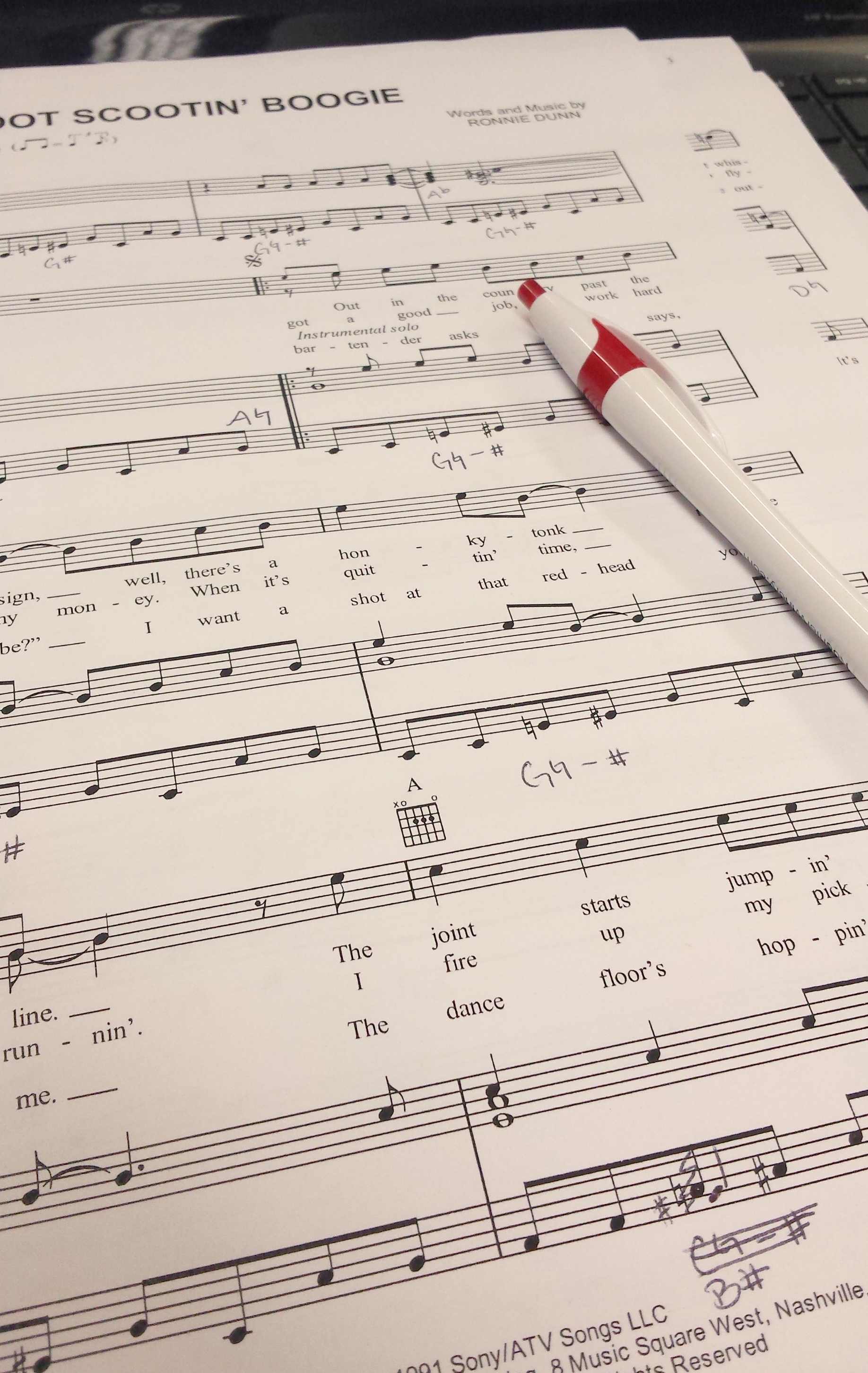
When I decided to arrange Boot Scootin' Boogie for the harp, I knew I wanted to have a starting point. That meant, for me, to have a piano arrangement that I could base my arrangement off of. I found a piano arrangement through Music Notes; a great resource to find almost any song in arrangements for many different instruments. After finding a piano score to Boot Scootin' Boogie, my first step was to go through it and write in my pedal markings (where I will have to change a pedal in order to hear the correct note). While going through to mark my pedals, I also had to pay attention to whether or not anything would need to be enharmonically re-spelled. In the picture below, you will be able to see that I had to re-spell a D sharp to and E flat as a D sharp and D natural were written (and not able to be played on the harp).

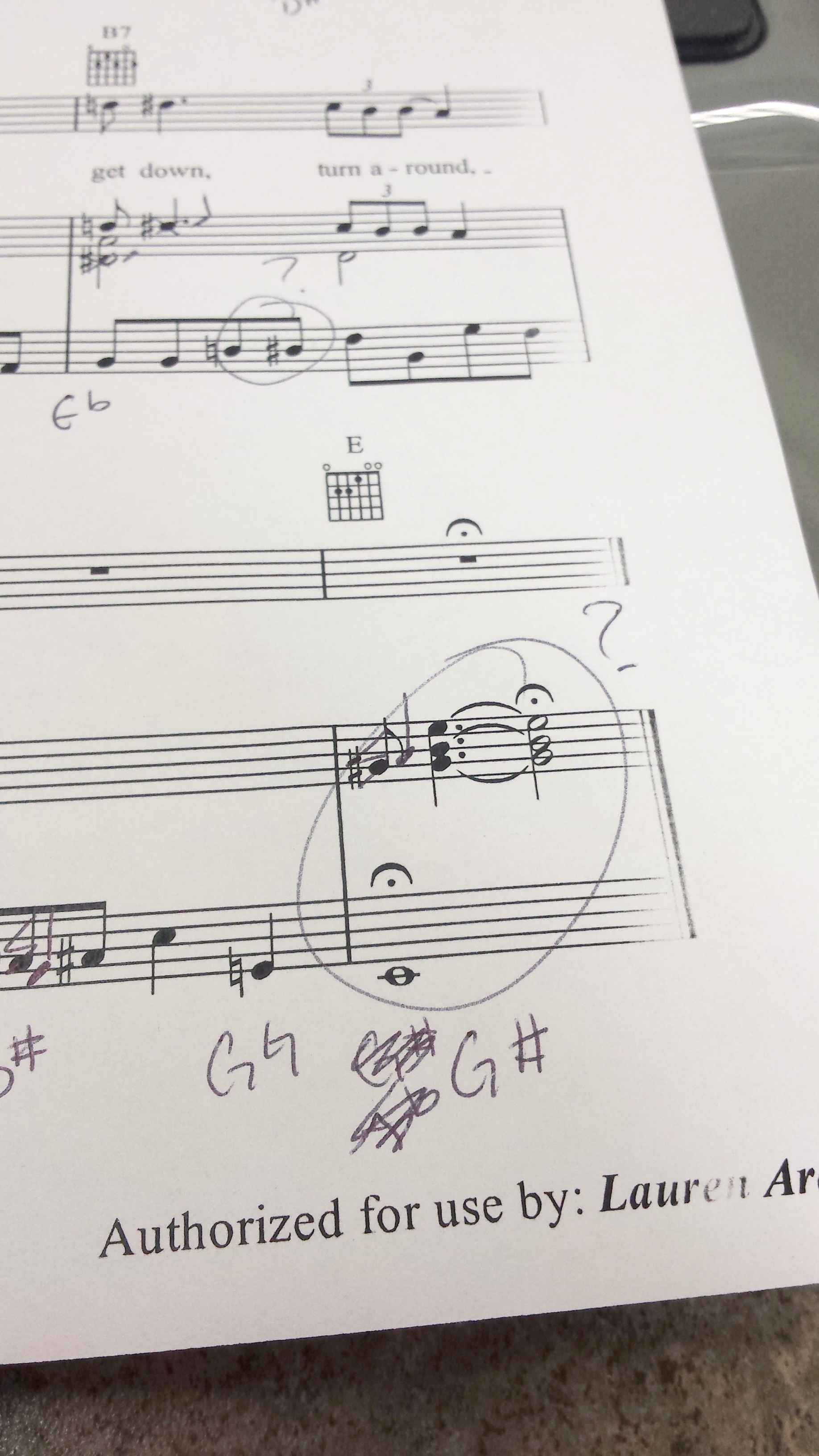
But, there are some sections that I come across that cannot be solved until I play with it while sitting at the harp. In these instances, I circle the problem section and put a question mark, as you can see below.
After putting in all of the pedal markings and circling possible problem areas, I get to start playing around with how I want the song to sound. For example, the intro to this song is a walking bass line which can be played a couple of different ways on the harp. Since the harp uses pedals to create sharps, naturals, and flats; it is possible to create a sliding sound from one pitch to the next. This is called a pedal slide. This walking bass line in the intro has a G natural to a G sharp which can either be played with or without a pedal slide. The two videos below demonstrate the two options.
Without pedal slide
With Pedal Slide
Today, the sun is a little duller than normal. Last night, my great grandfather passed away. He was the toughest, most stubborn, opinionated, strong, and loving man I have ever known... and I got to call him my grandpa! I think that my cousins words best sum up the man that he was:
"Seriously the toughest SOB I have ever known. Heaven didn't want him and hell was afraid he would take over. Cheated death at least a half dozen times, served in the Navy and the USMC. He had a magical green thumb, drank scotch every day and could catch every trout in a stream. After 96 years Saint Peter finally opened the gates and called him home. RIP Grandpa."
I cannot believe that you are gone, but I am so happy that you were in my life for so long. I miss you so much already! You had an amazing 96 years! I was lucky to be able to call a guy like you my great grandpa! You have been such an inspiration in my life! I'm dedicating this song to you Grandpa!
I love you so much, Grandpa Roach!
 In loving memory of my great grandfather, Harold Earl Roach, Jr.!